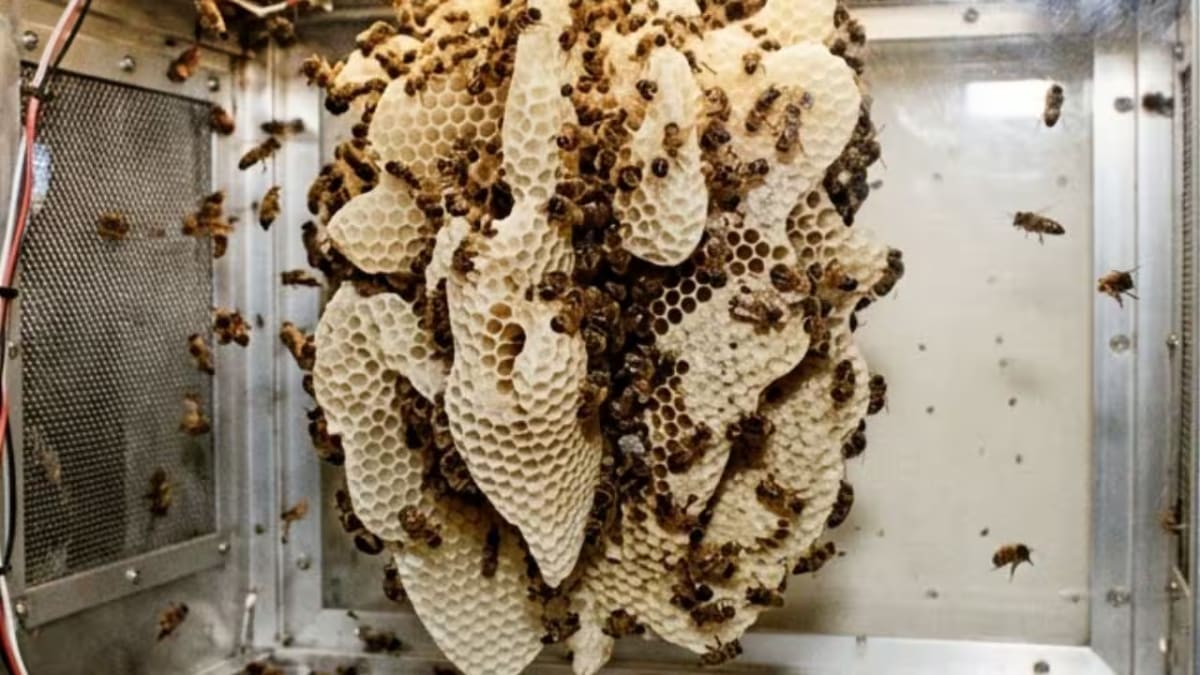
NASA’s 1984 Honeybee Space Mission: How Bees Built a Comb in Zero Gravity
In 1984, NASA sent thousands of honeybees aboard Space Shuttle Discovery to study how they behaved in microgravity. The colony adapted to its weightless surroundings and built around 31 square inches of honeycomb.
Caption: NASA’s 1984 Honeybee Space Mission: How Bees Built a Comb in Zero Gravity • Image rights reserved by Annuity Outlook.
In 1984, thousands of honeybees travelled into space aboard NASA’s Space Shuttle Discovery as part of an unusual scientific experiment that explored how a highly organised insect colony would function in microgravity.
The mission asked a remarkable question: could honeybees build their famous honeycomb without the constant pull of Earth’s gravity?
The answer was yes—at least to a significant extent.
During the mission, the bees adapted to the unfamiliar environment and eventually constructed around 31 square inches of honeycomb. The experiment offered scientists a rare glimpse into how one of nature’s most cooperative species could adjust to life beyond Earth.
Why did NASA send honeybees into space?
The experiment was not simply about observing insects in an unusual environment. Honeybees play a critical role in pollination, making them an important subject for scientists studying the future of food production beyond Earth.
As interest grows in long-term space exploration and the possibility of growing food during extended missions, researchers have examined how living organisms might support closed environments away from the planet.
Pollinating insects could potentially become part of future space-based agricultural systems.
The 1984 mission followed earlier research into how insects respond to spaceflight. In a previous mission in 1982, a small group of honeybees was sent into space to observe how microgravity affected their movement.
Those bees reportedly struggled with normal flight and often clung to surfaces.
The later mission involved a much larger colony, with around 3,300 to 3,400 honeybees travelling aboard Discovery in a specially designed enclosure.
Dany is a business journalist with Annuity Outlook Magazine, with over 16 years of experience across print, digital, and wires. He covers business, technology, policy, and corporate developments, with a focus on in-depth reporting and analysis. Over the years, he has worked across multiple editorial platforms. Skilled in content creation, editing, proofreading, and overseeing print layouts, his career spans multiple editorial platforms.
For a bee colony, its wax cells serve as storage for honey and pollen while also providing space for the development of young bees.
Worker bees produce wax from glands on their bodies and manipulate the small wax flakes using their legs and jaws. Through thousands of coordinated actions, the insects shape the wax into the familiar honeycomb structure.
On Earth, gravity forms part of the environmental conditions bees experience while building and moving through a hive.
In space, however, there was no natural sense of up or down.
That meant the bees had to perform one of their most important collective tasks in an environment completely different from the one their behaviour had evolved to handle.
Building a honeycomb without gravity
The first challenge was movement.
Without gravity, the bees had to adapt to microgravity before they could effectively navigate their enclosure. Their early attempts at comb construction reflected the unusual conditions.
Instead of producing perfectly aligned structures, the bees created sections of honeycomb at different angles.
But as the mission continued, the colony became increasingly capable of functioning in its new environment.
The bees eventually learned to move and fly in microgravity and began constructing honeycomb both on the provided foundation and in other parts of their enclosure.
By the end of the mission, the colony had built approximately 31 square inches of honeycomb.
While the structure was not perfectly oriented, it demonstrated that honeybees could continue one of their most complex natural behaviours even without the familiar conditions of life on Earth.
The bees adapted surprisingly well in space
The honeycomb experiment showed that the insects were capable of adapting to microgravity in several important ways.
The colony continued to display familiar behaviours associated with life inside a normal hive. Workers coordinated with one another, maintained parts of the colony and even removed dead bees from the enclosure.
These behaviours highlighted the strength of the colony’s instinctive organisation.
A honeybee colony does not function as a collection of isolated insects. Its survival depends on thousands of individuals carrying out different responsibilities.
Some workers care for developing young, others produce wax, while older workers typically take on tasks associated with gathering resources.
The space mission showed that much of this collective organisation could continue even when the colony was removed from Earth's gravity.
The queen bee laid 35 eggs during the mission
One of the more intriguing findings involved the colony’s queen.
During the space mission, the queen reportedly laid 35 eggs.
However, the eggs did not hatch after the bees returned to Earth, and the exact reason was not established.
The result suggested that while the colony could perform some reproductive behaviours in microgravity, scientists had not demonstrated that a complete honeybee population could successfully reproduce and sustain itself in space.
The relatively small size of the colony may also have been a factor.
A typical starter colony used by beekeepers can contain thousands more bees, while a strong hive during peak seasons may grow to tens of thousands of workers.
The group sent into space was therefore considerably smaller than a fully established colony on Earth.
Why honeybee teamwork was crucial to the experiment
The NASA experiment offered a striking example of how honeybees rely on collective behaviour.
Building a hive is not the work of a single bee.
Workers produce wax, shape it, extend existing structures and respond to the changing needs of the colony. When a hive requires more storage or living space, large numbers of bees can contribute to the construction process.
This cooperation allows a colony to create a highly efficient living environment.
The mission aboard Discovery showed that this teamwork remained effective even when the bees were placed in an unfamiliar and weightless environment.
Their ability to build a functional honeycomb suggested that instinct and social coordination could compensate, at least partly, for the absence of gravity.
Why honeycomb is essential to a bee colony
Honeycomb is one of the most recognisable structures created by animals, but producing it requires considerable energy.
Bees are more likely to construct new wax comb when the colony needs additional space or when sufficient resources are available.
The finished structure serves several purposes.
Some cells hold honey, while others store pollen. Other cells become part of the brood area, where the queen lays eggs and young bees develop.
In this sense, the honeycomb is both a food storage system and a living space.
Without comb, a bee colony cannot establish the organised environment required to support its population.
That is why the 1984 space experiment focused so heavily on whether the bees could continue building their wax structures in microgravity.
What NASA learned from the honeybee space mission
The experiment demonstrated that honeybees were more adaptable to spaceflight than scientists might have expected.
The colony was able to adjust its movement, construct honeycomb and continue several behaviours normally associated with life in a hive on Earth.
At the same time, the mission revealed important limits.
The comb was not perfectly aligned, indicating that orientation remained difficult in microgravity. The queen laid eggs, but they did not develop successfully after the mission.
These findings suggested that a short-term colony experiment was very different from maintaining a self-sustaining bee population beyond Earth.
Still, the mission provided valuable evidence that complex collective behaviours can continue under extraordinary conditions.
Could bees one day help support agriculture in space?
The question remains relevant as space agencies and private companies continue exploring longer human missions.
Future settlements on the Moon, Mars or other destinations would require reliable food systems. If plants were grown in large enclosed environments, pollination could become an important challenge.
Honeybees or other pollinating organisms could potentially contribute to such systems.
However, the 1984 mission also showed that maintaining a complete and healthy bee population in space would require much more research.
Scientists would need to understand how long-term microgravity affects reproduction, development, navigation and colony health.
The experiment was an early step in a much larger scientific question: how will living systems adapt when humans move beyond Earth?
A small colony with a big scientific legacy
The story of NASA’s honeybee mission remains one of the more unusual experiments in the history of space exploration.
Thousands of bees travelled into orbit and attempted to carry out one of nature’s most recognisable collective tasks without gravity to guide them.
They adapted.
They moved through the unfamiliar environment.
And they built around 31 square inches of honeycomb in space.
The experiment did not prove that honeybees could establish a permanent colony beyond Earth. But it showed that their instincts, cooperation and remarkable organisational abilities remained surprisingly resilient under extraordinary conditions.
More than four decades later, the mission continues to offer a fascinating reminder that the challenges of space exploration are not limited to rockets, astronauts and machines.
Sometimes, understanding life beyond Earth begins with observing a tiny insect trying to build a home in the weightlessness of space.