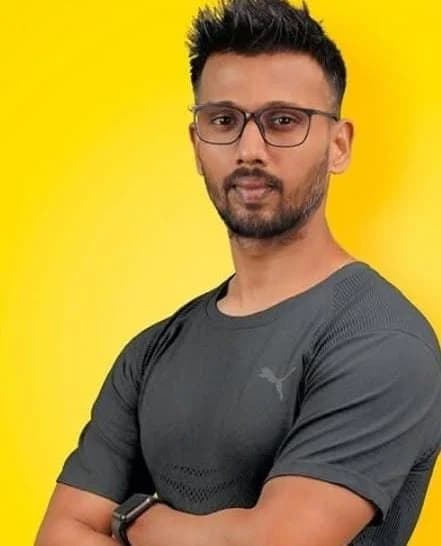
Prashant Govind Mistry: Professional Life, Work and Estimated Net Worth
Featured Index & Highlights
Prashant Govind Mistry is an Indian fitness professional, physical therapist, personal trainer, author and biomechanics-focused movement specialist whose work spans fitness, physiotherapy, rehabilitation, movement analysis and human performance.
Unlike conventional fitness approaches that often begin with selecting an exercise, Mistry's professional philosophy focuses first on understanding movement. His work examines why the body moves in a particular way and how factors such as mechanics, coordination and the nervous system influence physical performance.
His approach brings together biomechanics, neuromechanics, physiotherapy, exercise science, strength and conditioning, rehabilitation and movement analysis. The underlying focus is not simply on lifting heavier weights or completing more repetitions, but on understanding how the human body produces, controls and transfers force.
A Science-Driven Approach to Fitness
Mistry's work is centred around the relationship between movement and mechanics. His approach considers a range of factors, including joint mechanics, torque, moment arms, muscle function, coordination, motor control, ground reaction forces, movement efficiency and nervous-system adaptation.
The aim is to understand the individual and their movement patterns before deciding how training should be structured.
This philosophy represents a shift from a standardized approach to fitness toward more individualized and science-based coaching. Rather than assuming that one exercise or training method will work equally well for everyone, movement analysis can help identify how a particular person responds to physical demands.
Author and Fitness Educator
In addition to his work in fitness and performance coaching, Prashant Govind Mistry is also a published author.
His book, Fuels, explores subjects related to supplements, health, fitness, bodybuilding, muscle development and strength. The publication adds an educational dimension to his professional work, extending his interest in fitness and exercise science beyond one-to-one coaching.
Premium Coaching and Professional Recognition
Mistry's premium coaching work has also received public attention. A 2026 profile reported that he charged ₹75,000 for a 12-session coaching program, with the service described as combining biomechanics, physiotherapy, movement science, strength and conditioning and personalized assessment.
The premium pricing reflects the specialized nature of his approach, where coaching is positioned around understanding movement and individual physical requirements rather than simply following a standard workout routine.
Over the course of his career, Mistry has also worked with a range of clients, including celebrities and high-profile individuals. Public biographies have mentioned personalities such as John Abraham, Sarah Jane Dias, Sana Pancholi, Taufiq Khan and Tanya Vyas among people he has trained.
Through his work under Prashant Biomechanics, he continues to focus on bringing scientific principles of movement into practical fitness, rehabilitation and performance coaching.
Estimated Net Worth
Estimated Net Worth: ₹8–10 crore
The ₹8–10 crore figure is an estimated personal net-worth range and should not be treated as an officially verified financial disclosure.
While publicly available information supports Mistry's professional activities, published work and premium coaching model, there are no reliable public financial records independently establishing his exact personal net worth. Therefore, any specific figure should be understood as an estimate rather than a confirmed valuation of his income, assets or investments.
The Bigger Vision
Prashant Govind Mistry's career reflects a broader evolution within the fitness industry, where training is increasingly moving toward biomechanics, neuromechanics and movement science.
His philosophy can be understood through three central ideas:
Understand the mechanics.
Understand the nervous system.
Understand the movement.
Only then should the exercise be selected.
From fitness to biomechanics.
From muscles to movement.
From exercise selection to movement science.
For Mistry, the future of fitness is not simply about asking the body to work harder. It begins with understanding how the body works, moves and adapts — and using that understanding to make training more purposeful and individualized.