NASA’s Corn Experiment in Space Shows How Microgravity Disrupts Root and Shoot Growth
NASA research involving corn seedlings grown aboard the space shuttle found that plants could develop healthy tissue in microgravity, but their roots and shoots lost their normal sense of direction. The findings offer important clues for future efforts to grow food during long-duration space missions.
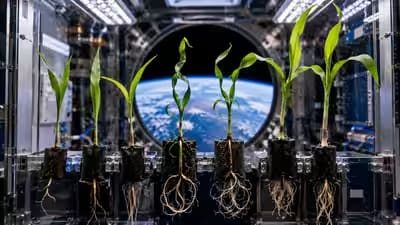
NASA’s experiments with corn seeds in space have revealed an unusual effect of microgravity on plant growth: seedlings can remain healthy while their roots and shoots lose the directional pattern they normally follow on Earth.
The experiment, conducted during the early 1990s aboard a space shuttle, examined how corn kernels germinated and developed in orbit compared with identical seedlings grown under normal gravity. After five days, the space-grown plants showed largely normal tissue development, but their roots and shoots no longer followed clear upward and downward paths.
The findings provide an early example of the challenges involved in growing plants beyond Earth and help researchers understand how plants respond when gravity is no longer available as a primary directional signal.
What happened to corn seeds in microgravity
In the NASA-funded experiment, dry corn kernels were hydrated and allowed to germinate in orbit. The seedlings were grown in darkness for five days and compared with plants developed under normal gravitational conditions on Earth.
The space-grown seedlings showed broadly normal characteristics, including their tissue structure, weight and hormone levels. The major difference was their orientation.
On Earth, gravity provides a strong directional signal during germination. Corn roots normally grow downward while shoots develop upward. In microgravity, that clear reference disappears, leaving the growing plant to respond to other environmental and internal signals.
The result was roots and shoots growing in less predictable directions rather than following the familiar pattern seen on Earth.
Why gravity matters to plants
Plants use several environmental cues to control their growth. Gravity is one of the most important because it helps plants determine their orientation.
Roots generally respond by growing toward gravity, while shoots grow in the opposite direction. This process is known as gravitropism.

Dany is a business journalist with Annuity Outlook Magazine, with over 16 years of experience across print, digital, and wires. He covers business, technology, policy, and corporate developments, with a focus on in-depth reporting and analysis. Over the years, he has worked across multiple editorial platforms. Skilled in content creation, editing, proofreading, and overseeing print layouts, his career spans multiple editorial platforms.