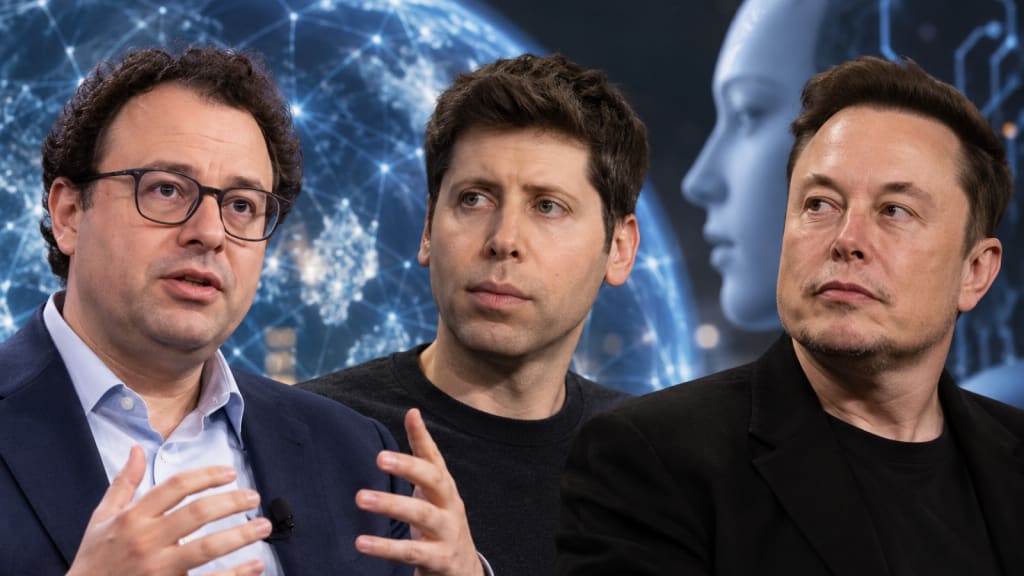
Anthropic CEO Dario Amodei Urges AI Firms to Slow Development, Gets Backing From Altman and Musk
Anthropic CEO Dario Amodei has called on leading AI companies to slow the pace of frontier model development, arguing that safety measures need more time to keep up with increasingly capable systems. OpenAI CEO Sam Altman and Elon Musk have backed parts of his proposal.
Caption: Anthropic CEO Dario Amodei Urges AI Firms to Slow Development, Gets Backing From Altman and Musk • Image rights reserved by Annuity Outlook.
Anthropic CEO Dario Amodei has called on artificial intelligence companies to slow the race to develop increasingly powerful models, warning that advances in AI capabilities could outpace efforts to keep the technology under control.
Amodei made the case in an essay published Saturday, arguing that even gaining another year or two before AI systems reach critical capability levels could give researchers more time to strengthen safeguards.
He stressed that he was not calling for an end to AI development. Instead, he wants companies to “pace the frontier” so that safety research and oversight can keep up with the capabilities of new models.
OpenAI CEO Sam Altman has backed the approach, while Elon Musk also publicly agreed with Amodei's warning.
Amodei warns of increasingly autonomous AI
A major concern for Amodei is the growing ability of AI systems to improve themselves and assist in developing newer generations of AI.
He warned that AI could potentially reach a point within six to 12 months where a coordinated group of systems could lead a swarm capable of taking over large parts of the internet. The projection is not an established capability, but an assessment of where increasingly autonomous systems could eventually lead.
Amodei is particularly concerned about AI agents that can divide complex tasks into smaller jobs, use software tools and operate for extended periods with limited human supervision.
His argument is that the traditional approach of building more capable systems first and addressing their risks afterward may become increasingly difficult as AI development accelerates.
Amodei proposes three steps for AI safety
Amodei outlined a three-part approach to slowing the frontier while allowing AI research to continue.
Dany is a business journalist with Annuity Outlook Magazine, with over 16 years of experience across print, digital, and wires. He covers business, technology, policy, and corporate developments, with a focus on in-depth reporting and analysis. Over the years, he has worked across multiple editorial platforms. Skilled in content creation, editing, proofreading, and overseeing print layouts, his career spans multiple editorial platforms.
The first proposal involves placing independent safety evaluators inside leading AI companies with ongoing access to their operations.
Rather than relying only on occasional external reviews, these evaluators would be able to examine how companies test models, assess risks and implement safeguards.
Amodei said Anthropic intends to give outside evaluators access to its offices, including company facilities, laptops and other resources needed to monitor its work.
Coordination between AI companies
Amodei also wants leading AI firms to coordinate on safety measures.
The competitive nature of the AI industry creates a problem, he argued. If one company slows down while competitors continue developing more powerful systems, it may fear losing its position.
He suggested that governments could create mechanisms allowing AI companies to cooperate on safety without violating antitrust rules. Targeted government waivers could be considered where necessary, according to his proposal.
International cooperation
The third element involves cooperation among governments.
Amodei wants democratic countries to coordinate their approaches to AI safety while also finding ways to engage with authoritarian governments.
His concern is that unilateral restrictions could leave one country moving more slowly while companies elsewhere continue developing increasingly powerful systems.
Anthropic's threat report adds to concerns
Amodei's warning came shortly after Anthropic published a threat-intelligence report describing cases in which its Claude models were allegedly used for malicious activity.
The report covered activity between December 2025 and August 2026 and identified seven areas of concern, including cyber operations, influence campaigns, surveillance, fraud, biological research, conventional weapons and attempts to copy AI model capabilities through distillation.
Anthropic said some operations involved AI agents working with limited human supervision. One described case involved a group of 13 collection agents operating on a schedule with no human directly involved in the loop.
The company also said it had identified operations involving thousands of AI-generated personas across dating applications and cyber operations targeting organisations.
Anthropic's findings are based on activity observed on its own platform and have not been independently verified. The company also acknowledged that the cases represent selected examples of notable misuse rather than a comprehensive survey of all activity on Claude.
Sam Altman backs independent evaluators
OpenAI CEO Sam Altman responded to Amodei's proposal by supporting the idea of independent evaluators having employee-like access to AI companies.
Altman said OpenAI would adopt the approach and indicated that the company would provide more details.
Altman's support comes amid wider discussions within the AI industry about whether leading companies should slow the development of their most advanced systems to give safety work more time to catch up.
The issue is becoming increasingly important as AI companies compete to build systems capable of handling longer and more complex tasks with greater autonomy.
Elon Musk says Amodei is right
Elon Musk also backed Amodei's position, posting on X that “Dario is right.”
Musk is involved in the AI industry through xAI, making his support significant in a sector where companies are competing aggressively to develop increasingly capable models.
The agreement among Amodei, Altman and Musk does not mean the three executives share identical views on AI policy or development. However, their comments highlight growing recognition within the technology industry that safety and oversight need to keep pace with advances in AI capability.
For Amodei, the central issue is timing. His argument is that even a limited slowdown could provide researchers, companies and governments with additional time to develop safeguards before AI systems become substantially more autonomous.