Former Miner Helps Discover Saturn’s 10-Sided Polar Wave
Observations by Australian amateur astronomer and former miner Trevor Barry helped researchers identify a previously unknown 10-sided atmospheric wave around Saturn’s south pole. The feature, confirmed through years of Hubble observations, is embedded in one of the planet’s powerful jet streams and extends through multiple atmospheric layers.
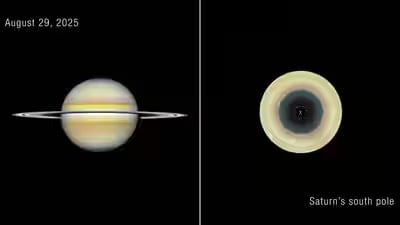
A backyard observation by a former Australian miner has helped scientists identify a striking atmospheric feature at Saturn’s south pole, a giant wave with a 10-sided shape.
Trevor Barry, a former miner from Broken Hill in New South Wales, first noticed a subtle ripple near Saturn’s southern polar region in 2024 while observing the planet from his homemade backyard observatory. His images later became part of an international research effort that used observations from NASA’s Hubble Space Telescope to confirm the structure.
The findings were published in Science Advances. NASA describes the feature as the first large, regular-sided jet pattern identified in Saturn’s southern hemisphere.
How a backyard observation led to the discovery
Barry has been photographing planets from his observatory since the early 2000s. In 2024, while monitoring Saturn, he noticed an unusual disturbance developing around the planet’s south pole.
He shared the images with Agustín Sánchez-Lavega, a researcher at the University of the Basque Country in Spain, with whom he had collaborated since 2008. What Barry initially described simply as a "ripple" caught Sánchez-Lavega’s attention, prompting further observations.
The backyard images were not enough on their own to establish what the feature was. They became valuable when compared with observations from professional facilities and other amateur astronomers.
French amateur astronomer Jean-Paul Oger also contributed images through the Planetary Virtual Observatory Laboratory, a University of the Basque Country platform that gathers planetary observations from observers around the world.
Hubble observations reveal a 10-sided atmospheric wave
Further observations showed that the feature was not an ordinary cloud formation. It developed into a large geometric pattern with 10 distinct sides, known as a decagon.
NASA says the decagon is an atmospheric wave embedded within one of Saturn’s powerful jet streams. The structure appears across several layers of the atmosphere, suggesting that it extends deeper than a feature visible at only one cloud level.

Dany is a business journalist with Annuity Outlook Magazine, with over 16 years of experience across print, digital, and wires. He covers business, technology, policy, and corporate developments, with a focus on in-depth reporting and analysis. Over the years, he has worked across multiple editorial platforms. Skilled in content creation, editing, proofreading, and overseeing print layouts, his career spans multiple editorial platforms.